Market Opportunity: Why Truly Gluten-Free Beer Is Bigger Than People Think
About 12 million Americans have a health reason to buy gluten-free; 4.6 million of them drink craft beer or cider; that is about 27 million cases a year, about $1.6 billion of beer at today's high-end craft six-pack price at full penetration. How Big Is the US Gluten-Free Beer Market? shows every step of that estimate and every assumption in it.
Most beers a brewery adds compete with its own shelf. Another hazy IPA, another pastry stout, another passion-fruit sour — they mostly chase the drinker who was already going to buy from you. The sale moves; it rarely grows.
Truly gluten-free beer is different. The person who needs it's the one currently putting your six-pack back down, steering the table to a different taproom, or drinking water at your bar. Serve them credibly and you add the occasion instead of reshuffling it.
The demand comes from people and occasions your regular lineup already fails to serve — see Why Gluten-Free Beer Adds Sales Without Cannibalizing Core Brands for the full logic.
And that demand is bigger than diagnosed celiac counts suggest, because the buying decision is rarely one isolated drinker. It often includes the gluten-free drinker, their spouse, their family, their friend group, the server, the retailer, and the label. One person's dietary need can steer the whole purchase — a group choosing a taproom does not split into five venues because one person needs a credible gluten-free option. They pick a place that works for the table.
Most breweries miss that market.
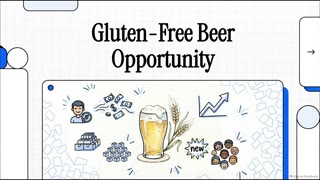 Watch on YouTubeWhy a Brewery Wants a Gluten-Free BeerThe whole market case in six minutes — the customer, the trust gap, the money, and the honesty check.
The mistake is counting one isolated drinker
Most breweries picture one diagnosed gluten-free customer standing alone in a store aisle. That picture is too small.
Sometimes the buyer is the gluten-free drinker. Sometimes it is the spouse buying beer for the fridge. Sometimes it's the friend choosing the taproom. Sometimes it is the server trying to answer a question without making the customer nervous. Sometimes it's the retailer deciding whether the beer belongs on shelf.
The gluten-free drinker may be the reason the purchase exists, but they are not always the person holding the six-pack.
That matters because the product has to work for more than one moment:
- the label has to be clear enough for the shopper;
- the beer has to taste good enough for repeat purchase;
- the claim has to be credible enough for the gluten-free drinker;
- the staff answer has to be specific enough to avoid killing the sale;
- the product has to give the group a reason to keep beer in the occasion.
A bartender who says, "I think it's gluten-free," just killed the sale.
How one gluten-free need can move through the purchase
Business question answered: where can one dietary need expand, redirect, or kill the beer purchase?
The market has more than one door
The 2019 planning work did one thing right: it did not flatten "gluten-free" into one customer.
It looked at several overlapping audience pools:
- Food Allergy / Gluten-Free
- Gluten-Sensitive
- Wellness
- Craft Beer Nerds
The exact 2019 population estimates are historical planning inputs, not current market facts. The useful point is simpler: people arrive at gluten-free beer for different reasons.
Some buyers are strict because they need to be. Some are avoiding gluten because they know how they feel after drinking ordinary beer. Some are ingredient-focused. Some are craft beer people who don't personally need gluten-free beer but influence whether the product gets taken seriously.
Those are not the same customer.
They don't all need the same message. They don't all carry the same risk tolerance. They do not all trust the same proof.
That's why a lazy gluten-free label is not enough.
For the sourced 2019 data itself — audience sizes, demographics, and the numbers behind everything on this page — see What the 2019 Audience Research Found. For the deeper audience breakdown, see The Four Gluten-Free Beer Audiences. For the purchase-influence version, see Who the Customer Actually Is.
Trust is part of the product
In normal beer, a vague claim may only be annoying.
In gluten-free beer, it can stop the purchase.
The buyer may read the label, scan the ingredient list, search the brewery site, ask the bartender, check a community recommendation, or text the person they are buying for. If the answer is fuzzy, the beer goes back on the shelf.
Trust affects trial, repeat purchase, recommendation, and whether the customer believes the beer belongs in their life at all.
Gluten-reduced beer and truly gluten-free beer make different market promises. Some drinkers may choose gluten-reduced beer knowingly. Others are buying the cleaner promise that gluten grains were not used from the start.
If the label makes the gluten-free drinker do homework, the brand already made the sale harder.
For the product-definition trust issue, see The Trust Gap. For the combined taste, safety confidence, and trust decision, see Taste, Safety, and Trust.
A good gluten-free beer can add occasions
Truly gluten-free beer can serve occasions ordinary beer does not serve well:
- the gluten-free drinker who wants beer but does not trust the options;
- the household shopper buying for someone else;
- the friend group choosing a venue where everyone can participate;
- the restaurant table asking whether there is a real beer option;
- the retailer helping a shopper who needs a clear answer;
- the craft beer drinker looking for a recommendation that tastes like beer, not apology.
That's where incremental demand can come from.
It is not a promise of zero cannibalization. It is not free money. It is access to people and occasions where the regular beer lineup is not doing the job.
For the deeper sales logic, see Why Gluten-Free Beer Adds Sales Without Cannibalizing Core Brands.
Where the audiences concentrate
The 2019 work also mapped the audiences by U.S. census division — not by state. It's a picture of where the gluten-free, gluten-sensitive, and wellness pools sit relative to premium-beer drinking, not a current ranking and not a claim about any one state.
2019 filtered health target by U.S. census division
Shading is the relative size of the 2019 "health target" — adults 21+ across Food-Allergy/Gluten-Free, Gluten-Sensitive, and Wellness, adjusted for overlap (not millennial-filtered; the sizing funnel applies that filter later). The blue outline marks the five divisions the study flagged as best-fit once it layered in super-premium-beer and hard-cider drinking, alcohol predisposition, and dietary-health need. That is why the largest single pool — South Atlantic (~3.0M) — is not a focus pick, while a smaller, higher-indexing division like Mountain is. Illustrative 2019 census-division planning data, not a state ranking and not a current market.
The same source lets you see raw pool size and fit side by side. Read the last two columns together — the biggest population and the best fit rarely land in the same division:
| Census division | Adults 21+ | GF / food-allergy | Gluten-sensitive | Wellness | Craft-beer | Filtered health target | Agency focus |
|---|---|---|---|---|---|---|---|
| South Atlantic | 49M | 0.3M | 1.1M | 2.6M | 2.3M | 3.0M | (scenario B) |
| Pacific | 39M | 0.3M | 0.6M | 1.7M | 2.3M | 1.9M | ● |
| Mid-Atlantic | 33M | 0.2M | 0.5M | 1.4M | 2.1M | 1.6M | ● |
| West South Central | 29M | 0.2M | 0.3M | 1.2M | 1.2M | 1.3M | |
| East North Central | 36M | 0.3M | 0.4M | 0.9M | 1.5M | 1.1M | |
| Mountain | 18M | 0.3M | 0.3M | 0.9M | 0.9M | 1.0M | ● |
| West North Central | 17M | 0.2M | 0.2M | 0.5M | 0.9M | 0.6M | ● |
| East South Central | 15M | 0.08M | 0.3M | 0.5M | 0.5M | 0.6M | |
| New England | 12M | 0.08M | 0.09M | 0.5M | 0.9M | 0.5M | ● |
The behavior indices (100 = national average) explain the focus picks. Gluten-free/food-allergy over-indexes hardest in Mountain (198) and West North Central (135); gluten-sensitivity in the South Atlantic (144); craft-beer enthusiasm in New England (155) and the Mid-Atlantic (126); and super-premium beer drinking in New England (163) and the Pacific (115). A large population and a high index seldom sit in the same place, which is the argument for filtering to a specific target instead of chasing headcount. The full regional layer — US map, every division's pools, and the complete nine-behavior index table — lives on Where the Audience Lives; the study context is on What the 2019 Audience Research Found.
What the scale can look like
These are illustrative planning figures, not current forecasts. They come from the 2019 research and are kept to show how the math behaves — not to promise a result. Validate every input against current data before treating any of it as a live claim.
This is not the national estimate on this site, and the two are not interchangeable. The table below is the study's own filtered-territory model at 2019 planning prices — one brand's reachable audience in five divisions. Our own estimate sizes the whole US audience at today's shelf price, and reconciles the two figures directly. To run the arithmetic on your own states instead of either, use the market calculator.
The two scenarios below are the study's own — they differ by which fifth division is included: Scenario A adds Mountain, Scenario B adds South Atlantic (both build on New England, Mid-Atlantic, West North Central, and Pacific).
| Planning input (2019 basis) | Scenario A | Scenario B |
|---|---|---|
| Filtered target population | ~1.3 million | ~1.4 million |
| Potential 6-pack volume (last 30 days) | ~2.6 million | ~2.9 million |
| Average price assumption | $10.99 | $10.99 |
| Modeled annual revenue — 3% share | ~$10.0M | ~$11.4M |
| — 5% share | ~$16.8M | ~$19.0M |
| — 10% share | ~$33.6M | ~$38.0M |
| — 20% share (stress test) | ~$67.2M | ~$76.0M |
Watch how fast the output moves when the share assumption moves, which is exactly why the assumptions have to stay visible. A focused, filtered gluten-free audience can support serious commercial math when the target is specific and execution is strong — it is not free money, and it is not a promise that any brewery captures a given share. For the full model, the inputs, and the honest limits, see Revenue Scenarios for a Truly Gluten-Free Beer.
Why Truly Gluten-Free matters
We use "truly gluten-free" on purpose.
The house standard starts with grains that belong in a gluten-free brewing system. It does not start with barley, wheat, rye, or oats and then try to fix the promise later with enzyme treatment, testing language, or clever wording.
That distinction matters commercially because trust is part of the product.
Some customers will accept gluten-reduced beer. Fine. But a strict gluten-free buyer may be looking for a different promise, and a brewery that blurs those categories is asking the buyer to carry the risk and confusion.
For the house definitions, see Truly Gluten-Free and Gluten-Reduced Beer Is Not Gluten-Free.
Where brewers usually get it wrong
| Bad Read | Better Read |
|---|---|
| The market is only diagnosed celiacs. | The market includes medical, sensitivity, wellness, craft, household, and social influence. |
| A gluten-free label is enough. | The buyer may want ingredients, process clarity, and clean gluten-free language. |
| Gluten-free beer is always a sad substitute. | Bad beer is a sad substitute. Good truly gluten-free beer can compete on taste and trust together. |
| If the beer exists, the audience will find it. | The product needs clear shelf, menu, mobile, staff, and community signals. |
| Marketing can hide weak brewing. | The business case depends on grain choice, malt quality, process, flavor, and repeatability. |
The market is not begging for another sad substitute beer. It's waiting for someone to make a gluten-free beer that acts like real beer.
What this means for the business
For breweries, the question is whether the brewery can build a credible beer around a customer existing beer does not serve well:
- Can the beer taste good enough for a second six-pack?
- Can the process support the claim?
- Can staff explain it without guessing?
- Can the label answer the obvious questions?
- Can the product create occasions the existing lineup can't?
For maltsters and ingredient suppliers, the opportunity is technical. Truly gluten-free beer needs better grains, better malt, better lot control, and better brewing data. Sorghum malt, millet malt, rice, corn, buckwheat, enzyme strategy, and quality systems are part of the commercial foundation.
For investors and product developers, the lesson is restraint. The category is interesting because it is underserved and trust-heavy, not because every broad wellness trend automatically turns into beer demand.
For smaller-brand strategy, see Outsmart vs. Outspend. For the sorghum-specific business argument, see The Sorghum Malt Opportunity.
How to use the market section
The Market section has six jobs.
| Section Job | Use It To Answer | Start Here |
|---|---|---|
| Buyer and customer logic | Who is involved in the purchase, what they mistrust, and how the decision moves through households, groups, labels, staff, and communities. | Who the Customer Actually Is |
| Trust and category distinction | Why truly gluten-free and gluten-reduced beer may sit near each other without making the same promise. | The Trust Gap |
| Brewery strategy | Whether a brewery should enter, partner, pilot, add a line, focus regionally, or wait. | Brewery Add-On Strategy |
| Revenue and market discipline | How to model opportunity without turning old assumptions into current forecasts. | Revenue Scenarios |
| Your own territory | What the audience, the annual cases and the shelf value look like for the states you actually sell in. | Market Calculator |
| Sorghum malt opportunity | Why a malted gluten-free grain path can matter commercially, not just technically. | The Sorghum Malt Opportunity |
The old generic market question was, "Is there a gluten-free beer audience?"
The better operating question is, "Can we make a beer, claim, channel story, and trust system that this buyer can understand and recommend?"
Bottom line
Many people evaluate gluten-free beer too narrowly.
The opportunity is larger than celiac diagnosis counts because the buying system includes multiple audiences, trust behavior, group occasions, and unmet product expectations. A well-made truly gluten-free beer can serve people and situations that ordinary beer, gluten-reduced beer, and weak gluten-free substitutes often fail to serve.
That's a business case worth taking seriously.
Not hyping. Not inflating. Taking seriously.
Related reading
- The Four Gluten-Free Beer Audiences
- Who the Customer Actually Is
- The Information-Seeking Gluten-Free Buyer
- Taste, Safety, and Trust
- Why Community Builds Trust in Gluten-Free Beer
- The Spouse, Family, and Friend-Group Multiplier
- Outsmart vs. Outspend
- Market Sizing Without Lying to Yourself
- The Trust Gap
- The Brewery Add-On Strategy
- The Competitive Gap
- The Sorghum Malt Opportunity
- Truly Gluten-Free
- Gluten-Reduced Beer Is Not Gluten-Free
- Quality Assurance Overview
- Contact Info
Claim boundaries
The 2019 planning work is used here as historical planning support for audience definitions, behavior patterns, trust/community/mobile implications, family/spouse logic, and market-framing strategy.
The 2019 audience estimates, regional scenarios, revenue projections, and demographic findings are not current market facts. Current market-size, growth, regional, retail, and revenue claims need current validation before they are used as live claims.