The Reliable Mash at Homebrew Scale
The Reliable Mash is the real thing: a 100% sorghum malt enzyme mash we ran commercially for years. The protocol page owns the controlling values. This page answers the question that page can't: what does it look like in a 10-gallon kettle in a garage?
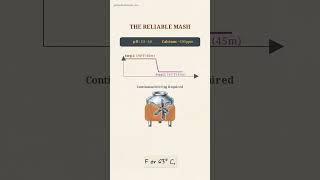 Watch on YouTubeThe Reliable Mash, Step by StepThe protocol as a run sheet — every step, in order, in ninety seconds. AI-generated from the production page and reviewed for accuracy.
The batch this assumes
A 5-gallon batch from 10 lb (4.5 kg) sorghum malt. Scale everything below proportionally for a different grain bill — the doses are per-pound for exactly that reason.
The numbers, translated
| Stage | Target | Time | Additions for 10 lb malt |
|---|---|---|---|
| Liquefy | 190°F (88°C) | 60 min | ~3.1 gal (11.8 L) strike water at 2.6 L/kg; 10 mL Termamyl SC DS in the water before the grain |
| Convert | 145°F (63°C) | 45 min | Cold water to hit temperature (~1.5–2 gal, 5.7–7.6 L); 15 mL Ondea Pro + 7.5 mL Termamyl SC DS |
| Finish | 145°F (63°C) | 10 min | 7.5 mL Amylase AG 300L |
| Mash out | 180°F (82°C) | 10 min | ~0.5 lb (0.23 kg) rice hulls, mixed 5–10 min before transfer |
Dose basis: Termamyl 1 mL/lb at mash-in and 0.75 mL/lb at coolback; Ondea Pro 1.5 mL/lb; Amylase AG 300L 0.75 mL/lb. Water 2.2–3.0 L/kg initial — the range production actually ran.
Volumes, so the kettle is not a surprise. Strike water (11.8 L) plus the coolback (about 7 L of 60°F tap water, by heat balance) is about 19 L of liquor. The grain holds back about a litre per kilogram, the usual planning figure, so expect roughly 3.8 gal (14.4 L) of runoff before any sparge. A 60-minute homebrew boil for 5 gallons typically wants around 6.5 gal (24.5 L) in the kettle, so plan a sparge of about 2.5 to 3 gal (10 L) at 180°F (82°C), or top up with water, and record which. This page had not stated the volumes until 2026-09-07.
Our doses run high, and you should know that
Set our rates beside the community reference the Zero Tolerance Gluten Free Homebrew Club maintains, and the gap is not subtle:
| Enzyme | Community range (mL/lb) | This protocol | Where we sit |
|---|---|---|---|
| Termamyl | 0.227 – 0.363 | 1.0 at mash-in | ~2.8× their maximum |
| Ondea Pro | 0.181 – 1.134 | 1.5 | Above their maximum |
| AMG 300L | 0.227 – 1.588 | 0.75 | Comfortably mid-range |
This is deliberate, not a typo. Bard's dosed above the makers' rates on purpose — a 2019 note on methodology states the policy plainly: take the supplier's stated rate and double it, and at small batch sizes go a little higher still. That note was written about a different enzyme line (Amylex) and gives the philosophy, not the Termamyl number; the Termamyl number is the V12 production sheet, and the full ladder from the maker's handbook rate up to the 2019 pilot's 2.24 mL/lb is on the production page. An earlier version of this page carried that pilot figure as the baseline. These are production numbers from a brewery that valued a guaranteed conversion over an optimised enzyme bill.
Three things to weigh before you copy them:
- Product identity matters. The community table lists Termamyl L; this protocol runs Termamyl SC DS. Same family, not necessarily the same activity per mL. Some of that 2.8× may be product, not philosophy — check your own product's datasheet before assuming either number transfers.
- Enzymes cost money, and at homebrew scale that bites. A commercial brewery dosing generously is buying insurance against a lost 75-barrel batch. On 10 lb of grain, the arithmetic is different and the downside is a disappointing Saturday.
- Over-dosing is not free. A glucoamylase that outlives its welcome keeps working through the lauter and can quietly over-attenuate the wort — the mash-out step exists partly to stop that. See External Enzymes.
What we would actually suggest: run the published rates once so you have a known-good reference batch, then step down deliberately and record what happens. That's Ask 6 — how far can enzyme doses come down? — nobody has published where the floor is on sorghum malt, and a homebrewer with a notebook is exactly who could find it.
Scale it to your batch
The table above assumes 10 lb. Enter your actual grain weight and get every dose and volume scaled — same published rates, your numbers, printable:
Loading the calculator…
The three things that decide whether this works
1. Enzyme in the water before the grain. Heat your full strike volume to 190°F, dose the Termamyl, get the mash moving, then add malt slowly. Dumping grain into hot water without active enzyme is how you get a clumped, gelatinized brick. This is the single most important sentence on this page.
2. Stir continuously. Production had a motorized agitator; you have arms or a pump. Sorghum starch gelatinizes hot and thickens fast, and unstirred mash means scorching, uneven conversion, and a stuck runoff. This is the biggest reason a recirculating system earns its price — see Equipment for the Process.
3. Hit 180°F at mash-out. The finishing glucoamylase survives lower temperatures and keeps drying your wort during a slow homebrew lauter — and homebrew lauters are slow. If your beer finishes thinner than the numbers predicted, this is the first suspect.
What breaks at small scale
- Thermal mass. A 10-gallon kettle loses heat far faster than a 40-barrel tun. Insulate, or plan to fire the burner during holds — and measure the mash, not the setpoint.
- Enzyme sourcing. These are commercial products in liter jugs. Homebrew-scale suppliers repackage equivalents; if you substitute, match the enzyme class (heat-stable alpha-amylase for liquefaction, a brewing blend for conversion, glucoamylase for finishing) and follow the vendor's dose, not ours. Record what you used — that's the data.
- Cooling for the coolback. Production added measured cold water. At home, pre-measure your coolback water and chill it; hitting 145°F by guesswork wrecks the ratio you just calculated.
- Runoff. Sorghum has no husk. Rice hulls at mash-out are not optional at this scale unless you're brewing in a bag.
What we want to know
This translation has never been validated as a homebrew protocol — it's arithmetic on a production process, and arithmetic isn't a brew day. If you run it, tell us: your efficiency, mash behavior, runoff time, gravity, fermentation curve, and what you'd change. Contradictions are the most useful reports we can get.
Related
- The Reliable Mash — the controlling production values
- Why the 190°F Baseline Exists
- The Sugar Bible — why the finishing enzyme decides your beer's body
- Equipment for the Process