Working guidanceWe run this. It has produced results under the conditions stated on this page. · The full position record
The Reliable Mash: The Production Mash
We ran this baseline at commercial scale to make Bard’s Gold, a 100% sorghum-malt gluten-free beer: ~90% apparent attenuation, 4.87% ABV, 3.1 SRM, sound pH, microbiologically clean, diacetyl below threshold. The full panel and what it does not prove are below.
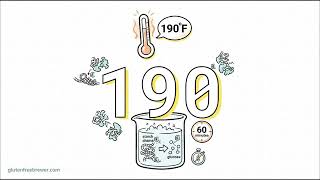 Watch on YouTubeHow a 100% Sorghum Mash Actually RunsThe protocol end to end, and the reasoning behind each step. AI-generated from this page and reviewed for accuracy.
The run sheet
The run sheet carries every target, addition, and stop condition. The thermal profile further down is the shape those steps produce: liquefy hot, cool into the conversion band, stage each enzyme, mash out, then run off to an iodine-negative endpoint.
Stir continuously. Most of what goes wrong in this mash traces back to settling, uneven heat, or poor enzyme contact.
100% Sorghum Malt Enzyme Mash
- Protocol
- GFB-RELIABLE
- Version
- Public 1.2
- Effective
- August 2026
Working baseline for 100% sorghum malt. Do not reuse this sequence for millet, rice, corn, or mixed-grist mashes.
Critical: Use the full 190°F (88°C), 60-minute liquefaction baseline; stage each enzyme at the specified temperature; stir continuously; record every change.
Stage before grain-in
Mash in and open the starch
- Do
- Bring the full liquor to temperature with the initial Termamyl dose already in the water, agitator at full speed. Then add the sorghum malt slowly — never dumped — so liquefaction keeps pace with gelatinization, and stir continuously through the hold. Rice hulls do NOT go in here; they are added at mash-out for the transfer.
- Add
- 100% sorghum malt, added slowly into enzyme-active hot liquor
- Termamyl SC DS: 1 mL/lb sorghum malt — in the water before any grain
- Advance when
- The full hold is complete and the mash remains evenly heated, mixed, and pumpable.
- Record
- Actual temperature path · Hold time in range · Mixing behavior · Enzyme product, dose, and lot
Cool and begin lower-temperature enzyme work
- Do
- Cool or dilute according to the pre-calculated plan. Add Ondea Pro and the second Termamyl dose, then continue stirring.
- Add
- Ondea Pro: 1.5 mL/lb sorghum malt
- Termamyl SC DS: 0.75 mL/lb sorghum malt
- Calculated cooling or dilution water
- Advance when
- The mash has completed 45 minutes at the target conversion temperature.
- Record
- Cooling water added · Final mash thickness · Actual pH · Time at target temperature
Finish the fermentability work
- Do
- Keep the mash at conversion temperature, add Amylase AG 300L, and continue mixing through the finishing hold.
- Add
- Amylase AG 300L: 0.75 mL/lb sorghum malt
- Advance when
- The 10-minute finishing-enzyme hold is complete.
- Record
- Addition time · Enzyme product, dose, and lot · Temperature · Hold time
Raise the mash for wort separation
- Do
- Raise the mash to 180°F (82°C) while continuing to mix; the glucoamylase can survive lower mash-out temperatures through a slow lauter and quietly over-attenuate the wort. Add the rice hulls now and mix 5–10 minutes before transfer — they are runoff structure, not a mash ingredient, and they do their job in the lauter bed. Do not shorten the scheduled conversion or finishing holds.
- Add
- Rice hulls: begin around 5% of malt weight when bed behavior is uncertain; mix 5–10 minutes before transfer
- Advance when
- The 10-minute mash-out hold is complete and the mash is ready for separation.
- Record
- Ramp start and finish · Time at mash-out · Mixing behavior · Any approved deviation
Run off, verify the endpoint, and transfer
- Do
- Record the iodine sample point, separate the wort, track runoff and clarity, and transfer the wort to the kettle.
- Add
- None
- Advance when
- Final wort is iodine negative, kettle transfer is complete, and the batch record is filled in.
- Record
- Sample point, time, and temperature · Mash or wort sample · Runoff behavior · Wort clarity and gravity
| Step | Action | Target | Add | Advance when |
|---|---|---|---|---|
| 1. Liquefy: more detail | Bring the full liquor to temperature with the initial Termamyl dose already in the water, agitator at full speed. Then add the sorghum malt slowly — never dumped — so liquefaction keeps pace with gelatinization, and stir continuously through the hold. Rice hulls do NOT go in here; they are added at mash-out for the transfer. | 190°F (88°C) 60 minutes |
| The full hold is complete and the mash remains evenly heated, mixed, and pumpable. |
| 2. Convert: more detail | Cool or dilute according to the pre-calculated plan. Add Ondea Pro and the second Termamyl dose, then continue stirring. | 145°F (63°C) 45 minutes |
| The mash has completed 45 minutes at the target conversion temperature. |
| 3. Finish: more detail | Keep the mash at conversion temperature, add Amylase AG 300L, and continue mixing through the finishing hold. | 145°F (63°C) 10 minutes |
| The 10-minute finishing-enzyme hold is complete. |
| 4. Mash out: more detail | Raise the mash to 180°F (82°C) while continuing to mix; the glucoamylase can survive lower mash-out temperatures through a slow lauter and quietly over-attenuate the wort. Add the rice hulls now and mix 5–10 minutes before transfer — they are runoff structure, not a mash ingredient, and they do their job in the lauter bed. Do not shorten the scheduled conversion or finishing holds. | 180°F (82°C) 10 minutes |
| The 10-minute mash-out hold is complete and the mash is ready for separation. |
| 5. Separate: more detail | Record the iodine sample point, separate the wort, track runoff and clarity, and transfer the wort to the kettle. | Final wort Iodine negative | None | Final wort is iodine negative, kettle transfer is complete, and the batch record is filled in. |
Run each step with its checks and context
Use the run sheet during a routine mash. Use these expanded steps when setting up the process, training an operator, documenting a deviation, or diagnosing unexpected behavior.
Mash in and open the starch
Objective
Hydrate the sorghum, expose its starch, and make the mash evenly mixed and pumpable before lower-temperature conversion begins.
Operating instruction
Bring the full liquor to temperature with the initial Termamyl dose already in the water, agitator at full speed. Then add the sorghum malt slowly — never dumped — so liquefaction keeps pace with gelatinization, and stir continuously through the hold. Rice hulls do NOT go in here; they are added at mash-out for the transfer.
- 100% sorghum malt, added slowly into enzyme-active hot liquor
- Termamyl SC DS: 1 mL/lb sorghum malt — in the water before any grain
What good looks like
The full hold is complete and the mash remains evenly heated, mixed, and pumpable.
Watch for
Clumping, settling, uneven heating, rising mixer load, or a mash that does not become workable.
If this happens
Confirm temperature distribution, the initial Termamyl addition, and continuous mixing before changing rice-hull or enzyme dose.
Record
Actual temperature path · Hold time in range · Mixing behavior · Enzyme product, dose, and lot
Level 3 · Mechanism and evidence Why the 190°F baseline exists
Cool and begin lower-temperature enzyme work
Objective
Move the liquefied mash into the operating range for conversion and fermentability work without losing control of mash thickness or the batch record.
Operating instruction
Cool or dilute according to the pre-calculated plan. Add Ondea Pro and the second Termamyl dose, then continue stirring.
- Ondea Pro: 1.5 mL/lb sorghum malt
- Termamyl SC DS: 0.75 mL/lb sorghum malt
- Calculated cooling or dilution water
What good looks like
The mash has completed 45 minutes at the target conversion temperature.
Watch for
Overshooting the cooling target, incomplete mixing, or unrecorded dilution that makes later batches impossible to compare.
If this happens
Pause additions until the actual temperature and water addition are known. Correct the record first; do not guess the final mash thickness.
Record
Cooling water added · Final mash thickness · Actual pH · Time at target temperature
Level 3 · Mechanism and evidence External enzyme strategy
Finish the fermentability work
Objective
Give the finishing enzyme its scheduled contact time so the wort profile is built before mash-out stops the intended lower-temperature work.
Operating instruction
Keep the mash at conversion temperature, add Amylase AG 300L, and continue mixing through the finishing hold.
- Amylase AG 300L: 0.75 mL/lb sorghum malt
What good looks like
The 10-minute finishing-enzyme hold is complete.
Watch for
Raising to mash-out before the scheduled finishing hold is complete.
If this happens
Hold at 145°F (63°C) until the scheduled finishing contact time is complete. Record any early temperature movement as a protocol deviation.
Record
Addition time · Enzyme product, dose, and lot · Temperature · Hold time
Level 3 · Mechanism and evidence Enzyme conversion in the mash
Raise the mash for wort separation
Objective
End the intended enzyme work — including the glucoamylase, which is harder to stop than spec sheets suggest — then prepare the mash for controlled wort separation.
Operating instruction
Raise the mash to 180°F (82°C) while continuing to mix; the glucoamylase can survive lower mash-out temperatures through a slow lauter and quietly over-attenuate the wort. Add the rice hulls now and mix 5–10 minutes before transfer — they are runoff structure, not a mash ingredient, and they do their job in the lauter bed. Do not shorten the scheduled conversion or finishing holds.
- Rice hulls: begin around 5% of malt weight when bed behavior is uncertain; mix 5–10 minutes before transfer
What good looks like
The 10-minute mash-out hold is complete and the mash is ready for separation.
Watch for
An early temperature rise that cuts off intended enzyme-contact time.
If this happens
Verify that both 145°F (63°C) holds were completed before continuing. If they were shortened, record the deviation rather than silently extending another stage.
Record
Ramp start and finish · Time at mash-out · Mixing behavior · Any approved deviation
Level 3 · Mechanism and evidence Temperature programs
Run off, verify the endpoint, and transfer
Objective
Recover usable wort, distinguish conversion from separation behavior, and finish with an interpretable iodine result and complete batch record.
Operating instruction
Record the iodine sample point, separate the wort, track runoff and clarity, and transfer the wort to the kettle.
What good looks like
Final wort is iodine negative, kettle transfer is complete, and the batch record is filled in.
Watch for
Treating an intermediate positive iodine check as the final result or changing enzyme dose before locating the real bottleneck.
If this happens
Identify the sample point and confirm whether the problem is conversion, retained wort, compaction, or solids carryover before changing the next batch.
Record
Sample point, time, and temperature · Mash or wort sample · Runoff behavior · Wort clarity and gravity
Level 3 · Mechanism and evidence Sorghum mash challenges
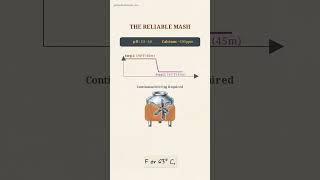 Watch on YouTubeThe Reliable Mash, Step by StepThe protocol as a run sheet — every step, in order, in ninety seconds. AI-generated from this page and reviewed for accuracy.
How the three relate
The Cereal Decoction was the first approach tried. The Maltose Mash is the design that ran as Bard's original production mash, and whose chemistry — through toll-processed extract — made most of the beer Bard's ever sold. The Reliable Mash is the redesign that replaced it on the brewhouse floor, and the one whose brewhouse records we hold.
Worth knowing before you run this: this is the one with the records — production data, an independent lab panel and four years of batch QA — which is what lets us help you diagnose a batch that goes sideways. It is not the beer Craig would brew. He would brew the Maltose Mash, and says so in his own words there. Run this one if you want the process we can support you on; run that one if you want the beer we would rather drink and will write down what happened. The two, side by side.
These used to be numbered Mash Protocol 1, 2 and 3. The numbers were retired on 2026-08-30 because they implied a sequence that was not merely uninformative but backwards: the numbering ran 1, 2, 3 while the history ran Cereal Decoction, Maltose Mash, Reliable Mash.
The February 2019 lab panel, and what it does not establish
This is not a theoretical recipe. We ran it at commercial scale to make Bard's Gold, a 100% sorghum-malt gluten-free beer that an independent lab measured as:
| Measure | Result | What it shows |
|---|---|---|
| Apparent attenuation | ~90% | The staged external-enzyme mash built a highly fermentable wort — fully converted, dry, clean |
| Alcohol by volume | 4.87% | On style for a sessionable gluten-free lager |
| Color | 3.1 SRM | Bright pale gold |
| pH | ~4.0 | Sound finished-beer pH |
| Wild yeast, aerobic + anaerobic bacteria | all negative | Microbiologically clean |
| Diacetyl | below threshold | Well-managed fermentation |
That confirms the beer is real and clean. It does not by itself establish the gluten-free claim — that rests on the pre-fermentation evidence in the QA Trust Chain.
The figures above are from an independent brewing QC laboratory panel on the finished flagship, February 2019. That panel itself is not published — it sits in the source archive, and this table is what it recorded. What is published, and checkable, is the surrounding production evidence: the Production QA Log 2014–2017 carries 155 stage-by-stage batch records including the per-batch gliadin-negative results, the LCBO finished-beer certificates are a regulator's own numbers on the same beer, and Fermentation Management sets the February 2019 figures against four years of RDF data.
On the 60-minute liquefaction hold
A 30-minute hold at 190°F (88°C) worked in most of our runs. The 60 minutes specified below is production insurance against malt-lot, equipment, heating, mixing, and scale variability — not the minimum time conversion requires. A 100-minute hold is the belt-and-braces option where a failed batch is not survivable. All three rungs, and how to choose, are on the liquefaction ladder. Validate a shorter hold on your own malt and equipment across several batches before you adopt it. See why the 190°F baseline exists.
Where the source documents disagree with each other
Four production documents describe this mash. They agree on nearly everything, and where they don't, we say so rather than pick a winner quietly.
The 145°F conversion step. Three of the four give 45 minutes. One — plausibly an earlier or parallel working draft — gives 35. The run sheet carries 45 because that's the better-supported value; the 35-minute document exists and disagrees, and a reader validating this on their own system should know that.
The water-to-malt ratio. The documents carry 1.0, 1.2 and 1.4 qt/lb between them, attributed to different sources and calculation paths within the same spreadsheet. That is why the sheet states a range rather than one figure: production ran both ends of it.
Neither disagreement touches the protected baseline — the 190°F, 60-minute liquefaction is unanimous across every source found.
If you've brewed barley, this temperature is where your instincts object
A barley mash lives around 148–162°F (64–72°C) because conversion depends on the malt's own enzymes, and heat like this would end them. That instinct is correct for barley. Here it's exactly backwards. In the GFB method, conversion does not depend on the malt's enzymes at all: external enzymes own it, and the liquefaction enzyme added at this step is chosen to work at this heat. Sorghum starch also gelatinizes hotter than barley starch, so the mash needs this temperature to open the starch in the first place. The 190°F (88°C) hold is not a hazard to survive. It is the reason the rest of the protocol works.
Scale this protocol to your batch
Enter your sorghum-malt weight to scale the documented per-pound additions. This is a planning aid for the working baseline above — validate the result on your own malt and equipment.
| Addition | When | Basis | Your batch |
|---|---|---|---|
| Initial water | Mash-in | ≈ 1.4 qt/lb | 140 qt35 gal |
| Rice hulls | Mash-out (when bed behavior is uncertain) | ≈ 5% of malt weight | 5 lb |
| Termamyl SC DS | 190°F (88°C) — liquefaction, at mash-in | 1 mL/lb (V12 sheet; corrected from the pilot's 2 mL/lb on 2026-09-07) | 100 mL |
| Ondea Pro | 145°F (63°C) — conversion | 1.5 mL/lb | 150 mL |
| Termamyl SC DS (2nd dose) | 145°F (63°C) — conversion | 0.75 mL/lb | 75 mL |
| Amylase AG 300L | 145°F (63°C) — finishing | 0.75 mL/lb | 75 mL |
Scales the documented per-pound basis of The Reliable Mash to your grain bill. It is a starting point to validate on your own malt, water, and equipment — not a universal recommendation. Cooling/dilution water is calculated separately (add only what reaches 145°F), and pH 5.5–5.6 and ≈ 100 ppm calcium are targets set against your source water, not quantities that scale with grain weight. Record the actual product, dose, and lot for every addition.
After the run
The batch reached its operating endpoint.
- Final wort is iodine negative.
- Runoff behavior is normal for the equipment and grist.
- Target gravity is reached.
- The batch record is complete.
Do not change the next batch from a guess.
For stuck or slow runoff, weak conversion, or unusual mash behavior, identify the bottleneck in Sorghum Mash Challenges before changing enzyme dose or temperature.
Interpret the iodine result
Don't treat an intermediate positive mash iodine check as the final result. Starch-degrading enzymes may continue working during wort separation; final wort should be iodine negative.
Record the sample point, time, temperature, result, and whether the sample was mash or wort.
Complete the batch record
- GFB-RELIABLE, public version 1.2, and any approved deviation
- Sorghum malt lot and crush profile
- Enzyme product, dose, lot, and addition time
- Source water and mineral, acid, chloride, and sulfate additions
- Initial and cooling water, final mash thickness, and rice-hull use
- Actual pH, temperature path, and hold times
- Stirring, settling, clumping, mixer load, and other handling observations
- Iodine sample point and result
- Gravity, runoff behavior, and wort clarity or turbidity
- Fermentation performance, attenuation, and final gravity
- Finished-beer body, dryness, mouthfeel, balance, and sensory notes
→ Print or download the blank batch record — a print-ready sheet for the brewhouse (also saves as PDF).
See Batch Records for the complete recording system.
Technical basis and open questions
Technical basisThe 190°F (88°C), 60-minute hold is our conservative production baseline for repeatability.
We ran this hold at Bard's across changing malt lots, equipment, and production conditions, and it was highly reliable in the runs our records preserve. We keep it as a deliberately conservative baseline — not because it's mandatory, and not because we have proven it optimal.
Open research questionLower temperatures or shorter holds may work, but the reliable boundary has not been established.
The open question is how far the temperature, the hold time, or both can be reduced without sacrificing liquefaction, mash handling, extract, runoff, fermentation performance, finished-beer quality, or repeatability across malt lots and equipment. A useful study compares controlled alternatives across multiple batches and malt lots rather than treating one successful batch as proof.
Reference valuesWorking dosing and process basis
| Item | Protocol value | Notes |
|---|---|---|
| Sorghum malt basis | 100% sorghum malt | Dose enzymes per lb of sorghum malt. |
| Water-to-malt ratio | 2.2–3.0 L/kg (about 1.0–1.4 qt/lb) initial, with cooling/dilution water recorded separately | Production ran both ends of this range. State the units whenever you write a ratio down — L/kg and qt/lb differ by ~2×, and an unlabeled ratio reads as a conflict when it is really arithmetic. Record initial water, cooling/dilution water, and final mash thickness after the mash reaches 145°F (63°C). |
| Cooling/dilution water | Calculated separately before mash-in | Add only what is needed to reach 145°F (63°C); record added water and final mash thickness. |
| Rice hull basis | Begin around 5% of sorghum malt weight when bed behavior is uncertain, then reduce where experience shows less is sufficient — added at mash-out, mixed 5–10 minutes before transfer | Hulls are runoff structure, not a mash ingredient: they do their work in the lauter bed, so they go in after conversion, not into the hot liquefaction. Working recommendation, not a fixed requirement. Adjust on bed structure, compaction, runoff, and wort separation. Record actual weight and timing. |
| Termamyl SC DS initial dose basis | 1 mL/lb sorghum malt | Add at the beginning of the 190°F (88°C) liquefaction step. Provenance in the next panel. |
| Ondea Pro dose basis | 1.5 mL/lb sorghum malt | Add after cooling or dilution to 145°F (63°C). |
| Additional Termamyl SC DS dose basis | 0.75 mL/lb sorghum malt | Add with Ondea Pro at 145°F (63°C). |
| Amylase AG 300L dose basis | 0.75 mL/lb sorghum malt | Add during the 145°F (63°C) finishing enzyme step. Glucoamylase finish → a glucose-forward wort: very fermentable and reliably dry. For what that means and the maltose-forward alternative, see The Sugar Bible. |
| pH target | 5.5 to 5.6 | Measure and record actual pH by step. |
| Calcium target / mineral condition | Approximately 100 ppm calcium | Current complete-process working baseline. Measure source water and record calculated additions and actual profile. |
| Chloride/sulfate note | Restrained where practical; process-specific, not universal | Track additions. Source water and beer style still matter, and high levels can interfere with enzyme performance. |
| Stirring requirement | Continuous stirring through the mash | Prevent settling, uneven heat, poor hydration, and weak enzyme contact. |
Reference valuesWhere the Termamyl dose comes from
The 1 mL/lb mash-in dose and the 0.75 mL/lb at coolback are the figures on Bard's last production sheet (Enhanced Protocol V12, July 2020). Every rung below was read from the source named; the doses are stated as each source wrote them, with the per-pound equivalent beside.
| Source | Dose as written | Per lb of sorghum malt |
|---|---|---|
| Novozymes Brewing Handbook 2013, p. 28 — Termamyl SC DS on a barley-adjunct cereal cooker | 0.42 lb (0.19 kg) per metric ton of adjunct | about 0.07 mL/lb |
| Homebrew community table (Zero Tolerance wiki, Termamyl L) | 0.227–0.363 mL/lb | 0.23–0.36 mL/lb |
| Bard's V12 protocol, the column headed "documented" | 600 mL per metric ton (about 0.27 mL/lb) | 0.27 mL/lb |
| Bard's V12 protocol, working sheet (July 2020) | 1 mL/lb at mash-in + 0.75 mL/lb at coolback | 1.75 mL/lb total |
| Bard's 42-barrel production brew, May 2020 | 9.5 lb (4.3 kg) of enzyme on 2,300 lb (1,043 kg) of malt | about 1.5 mL/lb total |
| Bard's pilot protocol v5/v6, November 2019 | 150 mL on 67 lb (30 kg) of malt | 2.24 mL/lb at mash-in |
An earlier version of this page carried the pilot's figure — 2 mL/lb at mash-in — as the production baseline; corrected to the V12 sheet on 2026-09-04. The maker's rate is what the enzyme needs to liquefy a barley-adjunct cereal cook. Sorghum on its own malt was run far above it on purpose, and the reasoning — guaranteed conversion over an optimised enzyme bill — is on the homebrew-scale page. Nobody has published the curve between the maker's rate and ours; that's Research Ask 6.
Reference rationaleApproximately 100 ppm calcium is a complete-process baseline, not a Termamyl minimum.
Novozymes brewing documentation states that Termamyl SC DS can operate at calcium levels below 20 ppm. That is a statement about what the enzyme can tolerate, and it is not the basis for the complete water profile we use here.
Our commercial records at Bard's, along with period distributor guidance on the Novozymes system, ran a higher complete-process calcium condition. We have not recovered the original reason for it. Until we do, target approximately 100 ppm calcium, calculate additions from your source-water profile, and record calcium, chloride, sulfate, acid, and salt additions.
Mechanism and evidence
How heat, Termamyl, and continuous stirring open starch and make the mash workable.
ConversionWhy the mash moves to 145°FHow the lower-temperature additions build fermentable, repeatable wort.
System designHow the staged enzymes work togetherThe role, limits, and sequence of the external-enzyme strategy — with the published evidence that external enzymes convert sorghum where native enzymes can't.